After the Call: Why First Responders Can’t Just “Shake It Off”
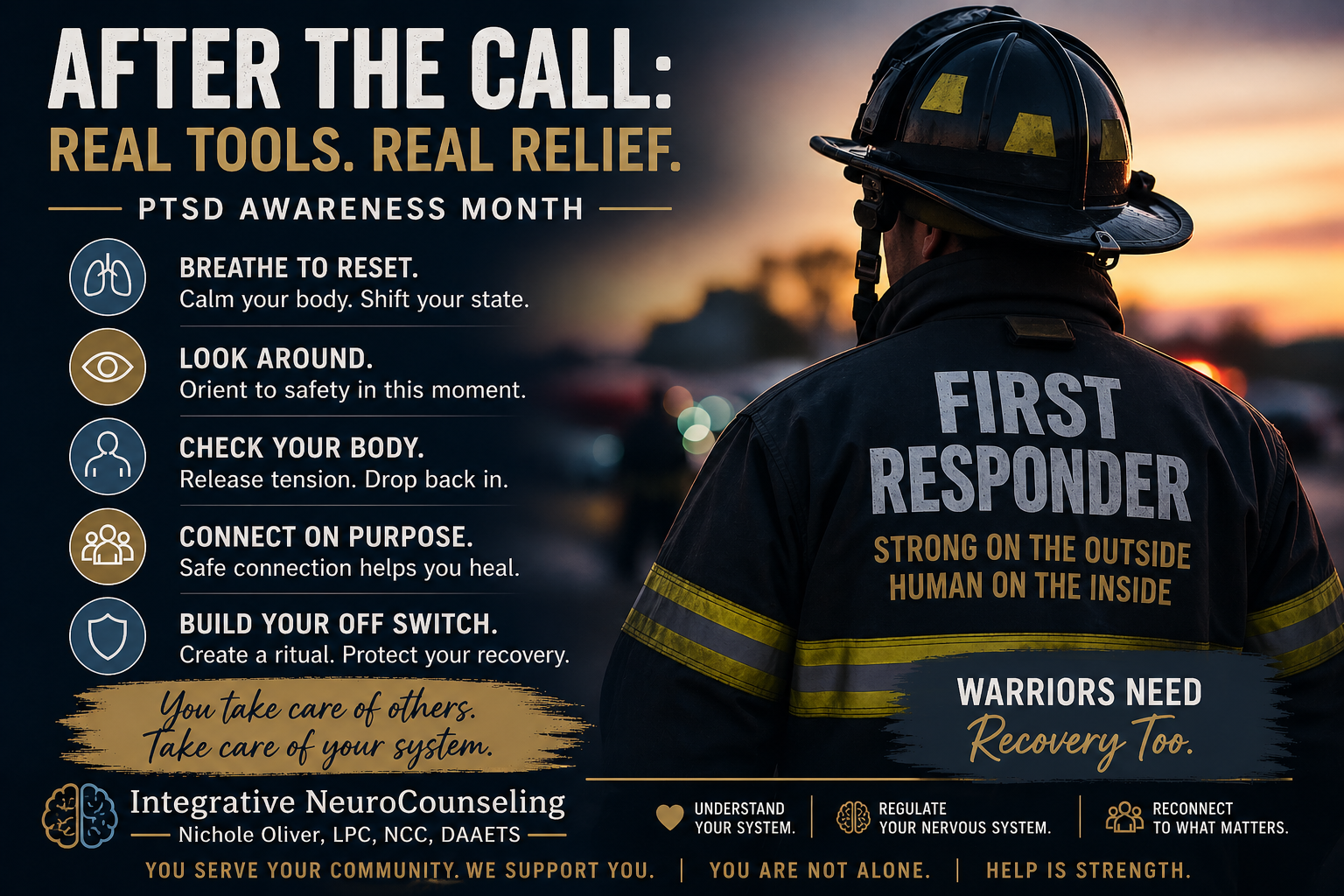
June 27th is PTSD Awareness, and for first responders, this conversation matters. Because trauma in this field isn’t rare, it’s repeated, cumulative, and often unprocessed. You're trained to stay calm, act fast, and handle what most people never see.
Why First Responders Can’t Just “Shake It Off”
But your nervous system doesn’t operate on willpower.
It operates on survival.
What’s Actually Happening in the Body
PTSD is not just about what you remember.
It’s about what your nervous system has learned to expect. With repeated exposure to stress and critical incidents:
- Your brain becomes faster at detecting threats
- Your body stays on standby, ready to respond
- Shutting it off becomes harder, even when you’re safe
This can look like:
- Difficulty sleeping or “powering down.”
- Irritable or short fuse
- Emotional numbness or detachment
- Always scanning, even off duty
That’s not weakness. That’s conditioning.
Why It Follows You Home
The same system that keeps you sharp on a call can make it hard to transition back to normal life. At work, hypervigilance = effective.
At home, hypervigilance = disconnection. You may notice:
- Trouble being present with family
- Overreacting or shutting down
- Feeling like you’re “on” all the time
This is because your nervous system hasn’t fully shifted out of survival mode.
A Key Shift: You Don’t Need to “Turn It Off”Yo- u Need to Shift States
The goal isn’t to eliminate your edge. It’s to build flexibility-the ability to move between states:
- On-duty (activation)
- Off-duty (recovery and connection)
Practical Skills You Can Use Right Now
These are simple, tactical tools you can use between calls or after shift:
1. Controlled Downshift (2–5 minutes)
After a call or at the end of the shift:
- Inhale through your nose for 4
- Exhale slowly through your mouth for 6–8
- Repeat for 2–5 minutes
This signals your nervous system:
“The threat has passed.” "Secure the perimeter and stand down!"
2. Orienting Reset
Your brain scans for danger automatically. Help it update:
- Look around and name 5 things you see
- Notice what’s not a threat
- Let your eyes move slowly, not sharply
This grounds you in present safety, not past calls.
3. Tactical Body Check
Quick internal scan:
- Jaw tight? Shoulders up? Hands clenched?
- Drop shoulders, unclench jaw, slow breath
Small physical shifts = big nervous system impact.
4. Relational Attunement (At Home)
You don’t have to explain everything—but connection matters. Try:
- “Give me a few minutes to decompress, then I’m yours.”
- Make eye contact, brief touch, or sit near someone you trust
Safe connection helps the nervous system reset faster than isolation.
5. Transition Ritual (End of Shift)
Create a consistent “off switch”:
- Change clothes immediately
- Sit in your car for 2 minutes and breathe
- Mentally say: “Work stays here. I’m going home.”
Your brain learns through repetition.
The Bigger Picture
From an interpersonal neurobiology perspective, your system is shaped by both experience and relationship. And through memory reconsolidation, those patterns can be updated, meaning what you’ve been through doesn’t have to keep driving how you feel and react now.
Final Thought
You were trained to handle the call. But most first responders were never trained to come down from it.
You don’t need to toughen up.
You need tools that work with your nervous system.
This PTSD Awareness Month
Check in with yourself. Not just:
“Am I doing my job well?”But:
“Is my system getting what it needs to recover?”