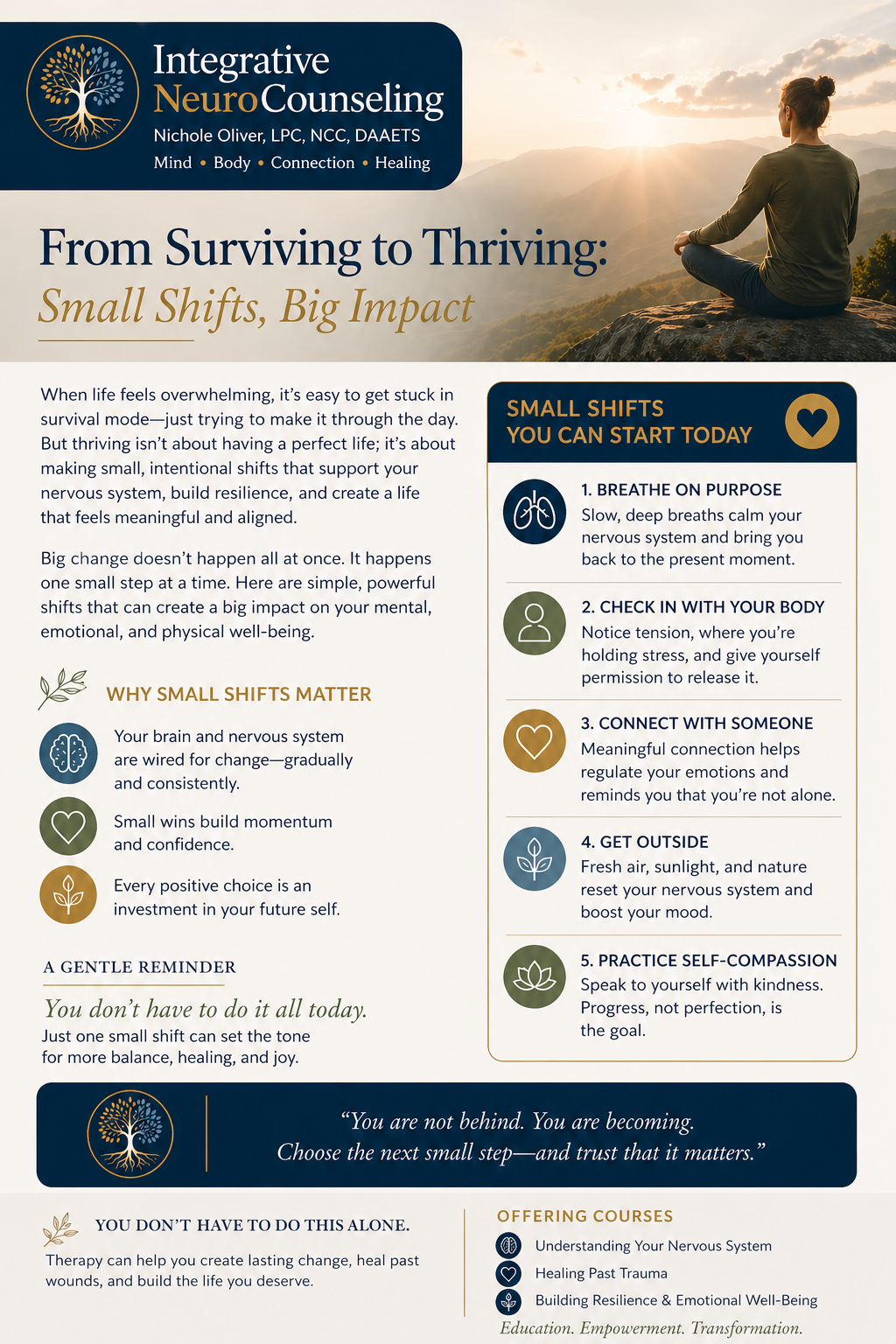
From Surviving to Thriving: Small Shifts, Big Impact
There are seasons in life where survival is the goal. You’re getting through the day. Managing responsibilities.Holding it together, for work, for family, for everyone who depends on you. From the outside, it may look like you’re functioning well. But internally, it can feel like you’re running on empty. If that’s you, you’re not alone. And more importantly:
You’re not meant to stay in survival mode.
Understanding Survival Mode
Survival mode isn’t a mindset-it’s a nervous system state. When stress becomes chronic, whether from trauma, burnout, health issues, or life demands, your system adapts to keep you going. It prioritizes:
- Efficiency over connection
- Reactivity over reflection
- Getting through over feeling fully
You may notice:
- Constant fatigue or wired-but-tired energy
- Irritability or emotional numbness
- Difficulty slowing down or being present
- Feeling disconnected from yourself or others
This isn’t failure. It’s adaptation.
But what helps you survive…is not what helps you thrive.
Thriving Isn’t a Leap- It’s a Shift
Many people think thriving requires a complete life overhaul. It doesn’t. In fact, your nervous system changes best through small, consistent shifts. (new neural connections like super highways).
Lasting transformation happens through repetition, not intensity.
This is how the brain builds new pathways. This is how the body learns safety again.
Why Small Shifts Matter (Neuroscience Made Simple)
- Signals safety to your nervous system
- Builds new neural connections
- Interrupts old patterns
- Creates momentum
Your brain and body are designed for efficiency. They don’t change because you understand something. They change because you experience something different repeatedly. Each small shift:
Over time, these micro-adjustments lead to macro change.
5 Small Shifts That Create Big Impact
You don’t have to do everything. Start with one.
1. Breathe on Purpose (2–3 minutes)
Slow, intentional breathing helps regulate your nervous system. Try: Dr. Andrew Huberman's lab is studying this breathwork and how it's actually cortisol
- Inhale through your nose for 2 separate breaths in
- Hold for 5 seconds
- Exhale slowly for 6–8
This simple shift tells your body:
“I’m safe right now.” Being and Feeling Embodied, Grounded and Holding in this present moment orients your brain and nervous system into interoception....
2. Check In With Your Body
Most people live in their heads. Healing happens when you reconnect to your body. Pause and ask:
- Where am I holding tension?
- What am I actually feeling?
Then soften- just 5–10%. (1% rule better in each area is 33% better by the end of the year)
3. Create Micro-Moments of Presence
Thriving isn’t about escaping your life—it’s about being in it. Try:
- Stepping outside for fresh air
- Putting your phone down for 5 minutes
- Noticing your surroundings
Presence rewires your system toward safety and awareness.
4. Prioritize Safe Connection
Your nervous system heals in connection- not isolation. (Co-regulation from Dr. Porges on Polyvagal Theory). This doesn’t have to be deep or long. It can be:
- Sitting near someone you trust
- Making eye contact
- Sending a quick message
Safe connection regulates your system faster than doing it alone.
5. Shift How You Speak to Yourself
Many people push themselves through survival with pressure and criticism. But thriving requires something different: self-compassion. Try:
- “I’m doing the best I can right now.”
- “It makes sense I feel this way.”
Your internal voice shapes your internal state. (SELF-TALK changes the subconscious programs and overrides old patterns, negative experiences, unwanted conditioning, and modeling from early life.)
From Surviving to Thriving
Thriving doesn’t mean everything is perfect.It means:
- You feel more regulated in your body
- You respond more than react
- You experience moments of connection and clarity
- You begin to feel like yourself again
Thriving is not a destination- it’s a direction.
A Gentle Reminder
You don’t have to fix everything today. You don’t have to overhaul your entire life. You just need to take one small step. And then repeat it.
Final Thought
You are not behind. You are not broken.
You are adapting AND, you are capable of changing your nervous system, updating your core beliefs and exepeincing new postive connection and being embodied safety, trusting yourself and your instincts to know what's best for you....
From surviving…to thriving…one small shift at a time.
Integrative NeuroCounseling - Nichole Oliver, LPC, NCC, DAAETS
Whole-Person. Whole-System. Real Transformation.