PTSD Isn’t Just in Your Head-It’s in Your Nervous System
Why Real Healing Happens from the Bottom Up
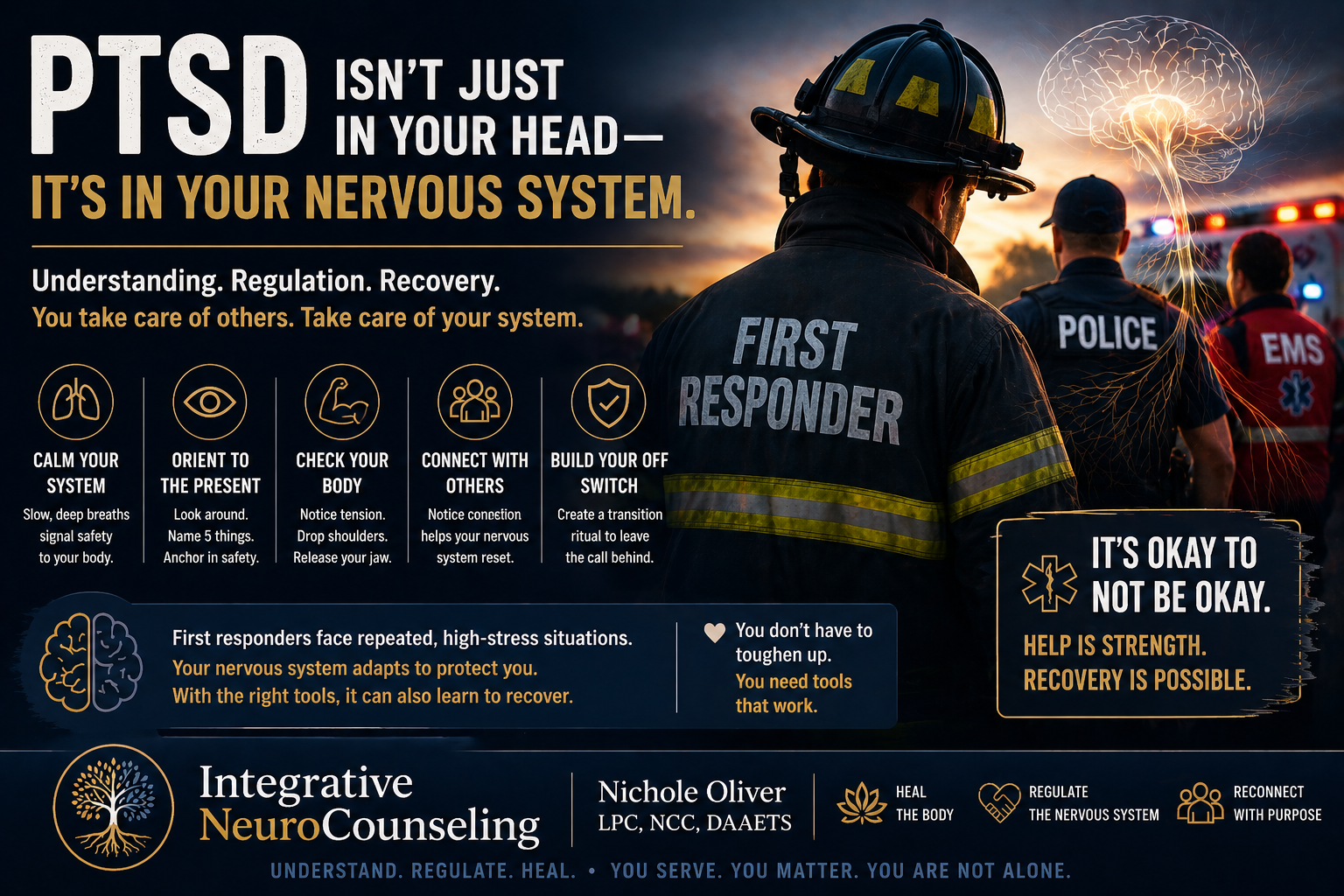
June is PTSD Awareness Month, and it’s time to rethink how we understand healing. For years, trauma treatment has focused on talking, insight, and coping skills. These can help, but they often miss something essential and deeper:
PTSD is not just psychological - it’s neurophysiological.
You can’t think your way out of a nervous system that’s wired for survival. For first responders, trauma isn’t rare-it’s repeated, cumulative, and often carried silently. High call volume, critical incidents, and the expectation to stay composed under pressure can train the nervous system to remain in a constant state of activation. Over time, the nervous system adapts to intensity, making it harder to power down, even off shift. What once helped you perform under pressure can begin to show up as irritability, sleep disruption, hypervigilance, or emotional shutdown. This isn’t weakness; it’s conditioning from doing your job well for too long without enough recovery.
What’s Really Happening in PTSD
PTSD is a nervous system adaptation, not a personal failure. After trauma, the body and brain can get stuck in survival states:
- Hypervigilance (fight/flight)
- Shutdown or numbness (freeze)
- Difficulty feeling safe, even when you are (hypervigilant)
That’s why so many people say:
“I know I’m safe, but my body doesn’t feel safe.” My mind is busy, and I am replaying calls, events, and conversations in my head, and I can't sleep. " I feel wired and tired."
Why Talk Therapy Isn’t Always Enough
Traditional therapy focuses on thoughts and insight. But when your nervous system is activated, the thinking brain goes offline.
If the body (Autonomic Nervous System) doesn’t feel safe, insight alone won’t create change.
This is why people can understand their trauma, yet still feel stuck in the same patterns.
The Shift: Bottom-Up Healing
Real healing starts with the body.
✔ Regulate the nervous system
✔ Restore a sense of safety
✔ Process stored survival responses
✔ Then integrate thoughts and meaning
When the body settles, the mind can follow.
How We Help Clients Heal
At Integrative NeuroCounseling, we use mind–body, neuroscience-informed approaches, including:
- EMDR – Reprocesses trauma so it no longer feels like a current threat
- Somatic/Nervous System Work – Releases stored stress and builds regulation
- Polyvagal-Informed Therapy – Helps you understand and shift your nervous system states
- HeartMath® Techniques – Practical tools for calming the body in real time
- NeuroSomatic Disentangling Method™ (NSDM) – My integrative approach to identify, separate, and rewire trauma-based patterns
- Interpersonal Neurobiology and Memory Reconsolidation-Through the lens of interpersonal neurobiology and memory reconsolidation, we understand that healing happens in safe, attuned relationships where the brain can update stored emotional memories, allowing past experiences to be reprocessed and no longer drive present-day reactions.
What Healing Looks Like
Healing doesn’t mean you’ll never feel triggered again.It means:
- Feeling safer in your body
- Responding instead of reacting
- Understanding your patterns without being controlled by them
- Reconnecting to your authentic self
You’re not broken. Your system adapted—and it can learn a new way.
There Is Hope
If you’ve tried therapy and still feel stuck, you’re not alone - and you’re not the problem. You may just need a different approach.
When the body settles, the mind can follow.
This PTSD Awareness Month, let’s shift the question:
From: “What’s wrong with me?”
To: “What happened to my system -and how can I heal?”
By: Nichole Oliver, LPC, NCC, DAAETS